From Lost Mono Tapes to Super-Deluxe Release: Bill Levenson on Wheels of Fire
Filed under: New Releases
8 Jun 26
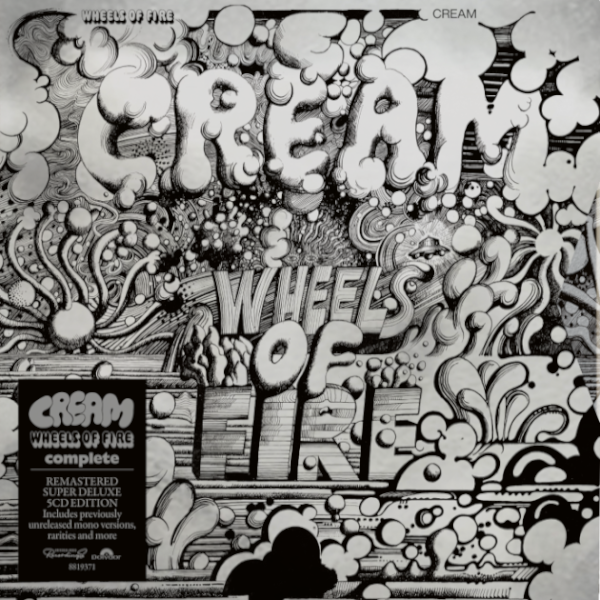
On June 12, Cream’s Wheels of Fire will be released in a super-deluxe edition featuring the long-lost original mono mix, outtakes, alternate mixes, live recordings, and a newly restored stereo version.
Formed in London in 1966, Cream was a highly influential British rock power trio widely regarded as the world’s first supergroup. The band brought together three virtuoso musicians considered the “cream” of the London scene: Eric Clapton on guitar and vocals, Jack Bruce on bass and lead vocals, and Ginger Baker on drums and vocals.
The band’s first two albums, Fresh Cream (1966) and Disraeli Gears (1967), were instant hits on both sides of the Atlantic, setting high expectations for Wheels Of Fire. A blockbuster upon its release in the summer of 1968, it became the world’s first platinum-selling double album. “White Room” reached the Top 10 on the U.S. singles chart, while “Crossroads” — featuring the now-iconic solo that established Eric Clapton as a global guitar hero — became a hit single in 1969, shortly after the group’s breakup.
This new set was put together by Grammy Award-winning reissue producer Bill Levenson. His extensive work on the Eric Clapton catalog includes Crossroads, Crossroads 2, Give Me Strength: The ’74/’75 Studio Recordings, the Slowhand 35th Anniversary Editions, and the soundtrack to Eric Clapton: Life In 12 Bars, as well as Cream’s Those Were The Days and the Layla and Other Assorted Love Songs anniversary editions by Derek & The Dominos.
Bill recently spoke with Where’s Eric! contributor Barry Fisch about the years-long process of assembling this landmark release. A record industry veteran who worked with Bill on the Crossroads box set while both were at PolyGram Records, Barry now manages the Long Island Music and Entertainment Hall of Fame Museum.
Not mentioned in their conversation is the backstory in which Where’s Eric! played an integral role. In the mid-’60s, Felix Pappalardi and his wife rented a carriage house on MacDougal Alley in New York City’s Greenwich Village. When they moved out in the early ’70s, they left behind hundreds of open-reel tapes, salvaged by the woman who rented them the space. The collection included recordings of the Youngbloods, whom he produced, as well as key parts of his work with Cream. About two decades ago, Kore Yoors, an artist and experienced collector, acquired them. A friend told him about a Where’s Eric! article seeking Eric Clapton archival rarities for possible use in a career-spanning documentary. Kore responded, bringing the recordings to the attention of Larry Yelen, who produced the Grammy nominated film Eric Clapton: Life in 12 Bars and a preeminent Clapton historian. “Without Where’s Eric!,” he said, “none of this would have been possible. I’m indebted to Linda Wnek and WE! for publicizing the search that helped bring these and other archival treasures to light.” Along with Grammy-nominated A&R expert Johnny Chandler, Larry helped construct the deal with Universal Music to purchase the tapes outright. Bill Levenson has since credited Larry, along with himself and Scooter Weintraub, as compilation producers of the Super Deluxe Edition.
The historically important reference tapes are released in this box set for the first time, offering a unique look at the evolution of the studio tracks. It can be pre-ordered here.
BF: You first heard Wheels of Fire when you were 14 years old. What are your memories of that time?
BL: I’m growing up on Staten Island, and WNEW-FM started broadcasting around 1967; that was my gateway. There was Creedence, there was Traffic, there was Cream’s Disraeli Gears. But, 1968, as I turned 14, I had my musical awakening. In the summertime, you had The Doors’ Waiting for the Sun, Cream’s Wheels of Fire, Jeff Beck’s Truth, and Jimi Hendrix’s Electric Ladyland. In the fall, the second Traffic album, The Beatles, and at the end of the year, The Rolling Stones [Beggars Banquet]. Of those records, Wheels of Fire had the most influence. I remember listening to it every day, staring at the cover, looking at the Day-Glo inner sleeve artwork. I took it with me to school, to baseball games, parties. It encapsulated everything about music in 1968. And, at 14, it became part of my DNA. I think it was the combination of the psychedelic, the blues, the whimsy.
It was an extraordinary event when that record came out. It was possibly my first exposure to a live recording. I’m pretty sure that I’d never been to a concert, and that record was my introduction to improvisational jamming.
When 1968 was over, all those records meant something to me, but Wheels of Fire stayed with me forever. It was only coincidence that years later I got to work with the tapes. That was something I couldn’t predict in 1968.
BF: A fire at Atlantic Records’ warehouse in Long Branch, New Jersey destroyed nearly 6,000 tapes of historic recording sessions, including Disraeli Gears and Wheels of Fire. Given those losses, can you talk about the importance of the Felix Pappalardi tapes as virtually the only surviving window into the Wheels of Fire sessions and Cream’s creative process?
BL: The fire was February ’78. The irony is Atlantic had no rights to the material at that point. It was RSO and Polydor, and in those days, catalog was not on anyone’s mind. When RSO took over control of the catalog, they didn’t go to Atlantic and retrieve their tapes, which they should have done in 1975 when they moved to Polydor. All this material would have been captured for posterity. It didn’t happen. An accident happened at Atlantic, and we lost that opportunity, unfortunately.
Wheels of Fire was due for a fresh reassessment, but you can’t do that unless you have additional material to give some fresh insight. The Felix tapes were the part of the project that gave us insight into the album’s development. The early UK recordings of “White Room” – you get to hear where it started. We know how it finished.
Now, we get to hear Felix’s rough mixes, what he was working with, and that he as the “fourth musician”, the added embellishments. At the end of the day, it gave us as a new assessment of the album: four versions to listen to with each giving a slightly different window into Wheels of Fire.
BF: People often point out that Cream existed for only two-and-a-half years and accomplished so much in that short time. Equally amazing is that they recorded three great studio albums in less than two of those years…
BL: And that was the norm for the time, too. But these were three great records. I think part of the reason why Wheels of Fire is overlooked a little bit is because so much emphasis is always put on in the discussion on Disraeli Gears. And I never understood why because I always thought Wheels of Fire was a step up from Disraeli Gears.
BF: The album can be considered a natural evolution, a complete left turn, it’s just different…
BL: And it’s a wholly different production style. What Felix brought to the record as literally a fourth member is pretty staggering. It was genius what he put into the record.
BF: Let’s jump into the chronology of how this deluxe edition came to be, starting with the “Felix Pappalardi reference reels” discovered by Kore Yoors. I recall an early meeting when Larry Yelen and I went to your office at UMG to discuss the tapes Kore had found.
BL: I think the project goes back a little further than that. We had done Disraeli Gears in the early 2000s. Wheels of Fire was always the sort of record you wanted to do something with. The problem was as a format, it was hard to work with; it was already a double album, a double CD, and was really awkward to do anything of value and put together something that had enough content. That goes back almost 25 years.
Around the time I left Universal in 2008, Larry, you and I had a discussion about the Kore Yoors tapes. I think I may have had snippets of the seven reels; 30-second snippets of some songs. I don’t remember when I got those.
BF: My understanding is that after Felix moved from his apartment, the tapes were first played – and those short samples created – at Showplace Studios in New Jersey around 2015.
BL: That sounds right. After I left Universal, the project went cold. Then maybe 2017 or 2018, Universal and I discussed doing a 50th Anniversary package. My guess is we wouldn’t have had much time to get it out for the 50th. I started working with Kevin Reeves, who was working out of the new Universal Nashville studio. We sent the Atlantic Studios master and safety tapes of Wheels of Fire to him and he did the transfers. Both were in good condition. We also did transfers of Live Cream, Live Cream Two, and all the pieces that were lying around.
Around the time Kevin and I finished the transfers of the Atlantic Studios tapes; the project was put on the shelf. There wasn’t a lot of interest then; there was some change in administration as always happens at record labels. The one person who kept it alive was the product manager, Gavin Fraser.
Around 2020, the Kore Yoors tapes came up again. Larry and Johnny Chandler at Universal were having a pretty robust conversation with Kore and handled the negotiation to get the tapes without my involvement. Then COVID struck and everything went quiet until 2024, when, either Johnny or Gavin, or both, got in touch with me and said let’s take the next year or two and put this thing together. In 2021, in midst of the negotiations, Larry brought the tapes to Winner Sound Studios on Long Island for a new transfer; this time to create protective copies of all seven reels and longer, one-minute samples.
I only got involved again shortly after the deal was closed. It started out looking like a seven CD set, but everything was compacted into five CDs. The first CD was the album as released, followed by the album with the de-CSG processing; the second disc was Felix Pappalardi’s reference reels. We had Wheels of Fire live, and the relevant recordings on Live Cream one and two, and the loose ends, assembled together as a rarities disc, along with some more of the Felix Pappalardi tapes, like the “White Room” early version.
I needed a recording studio to pull it all together because it was in pieces. I had the Winner Sound Studio files, the Luke Pacholski de-CSG’d files; the Kevin Reeves files and they all needed to be mastered so that it was a good listening experience. We chose Abbey Road, a Universal facility, to do the final mastering. Geoff Pesche at Abbey Road was sent everything in the summer of 2025, and he and I worked on putting it together. I was still not sure what we had or how it was going to come together, but it was just kind of magical; everything fell into place.
It was a very organic process of putting it together in one package, literally everything that’s crossed our path in 50 years. You’re only going to get one chance to do a project like this. Let’s present all of it. What turned out was a pretty compelling set. Granted, it’s a bit much for some people but what the package does is give you four views of Wheels of Fire: the studio, the original, the fix, and the stereo and mono references with the mono being the first time proper mono mixes are available. It might be overkill, but for those who take the time, it’s a compelling listen.
BF: Can you talk about the CSG process and “CSG removal?” What is it and why did you choose to remove it? There’s an entire disk of studio recordings in the set dedicated to “with CSG” and “without CSG.”
BL: My friend, Luke Pacholski, knew about de-CSG processing. He had the software and asked if I would be interested in him trying it out. I sent him the files Kevin did. He turned it around in a week and now we had tracks with CSG and without CSG.
But back in 1968, record labels were looking for a way to get away from dual mono and stereo inventory. Until that time, they kept mono and stereo inventories and released them simultaneously at different price points. Then the Holzer Audio Engineering compatible stereo generator system, the HAECO-CSG, came along. It was an attempt to take stereo recordings and process them so that they would be compatible with mono playback equipment.
And with HAECO-CSG the center channel where you put your vocals is not pinpoint. It meandered around. As a youngster, I listened to Wheels of Fire and over time, I accepted it as being a treatment in the mix; they were looking for that ethereal swirling vocal. My understanding is that the CSG process took one channel and threw it 180 degrees out of phase. It was that “out of phase” that allowed the stereo signal to be played on mono playback equipment. I’ve never heard it in a mono setting, so I don’t know what it sounds like, but we do hear how it affected the stereo phasing of the album.
So, when you apply CSG to say, “White Room,” and you’re focused on Jack Bruce’s vocal on the traditional version and you’re sitting in the sweet spot, the vocal never locks in. It’s a little bit here, a little bit there. It gets blurred. But, when you listen to the CSG-corrected one, it’s like a classic audiophile record. The vocal is dead center, it’s clean, it has no artifacts, and everything else is around it, the cymbals, everything has more focus. It locks it in. Of course, it’s system dependent. The better your system, the better your sweet spot, the more you’ll hear it.
BF: The mono mix of the album included in the set is the only known dedicated mono known to exist. This has long been discussed and sought after by serious fans and collectors.
BL: Well, I suspect there were mono issues around the world that I’m unaware of. But the one I am aware of came out in the UK. It’s simply a fold down, which is taking the stereo and compacting it to mono. And, it’s not a very good one. I bought a copy years ago because I always wanted to hear it. It’s a pretty hard listen. It’s claustrophobic. It’s one channel, but it’s all smushed together. But with the mono tracks that Felix created, they had more air to them, more breadth. They were prepared as mono. And for reasons we’ll never know, they decided not to use them. The sound is a bit bigger in some respects though I hate to use the word compressed.
BF: There’s often a unique power to mono mixes from the era.
BL: For sure. But again, I think it’s system dependent, and how people process how they want to hear their music. There are music fans who like to hear stuff in mono, and there are those who don’t, and vice versa. With this set, it’s an opportunity to hear Wheels of Fire both ways.
BF: Over the years, various Polydor releases, like in Japan, had some of these alternate mixes as bonus tracks. What’s “alternate” about the tracks in this set?
BL: “White Room,” the stereo US single edit as presented on Best of Cream, is a pretty unique version. The single edit was mono in America; they did a single stereo edit for the Best of, and it’s got its own characteristics, and a nice way to start the rarities disc.
“Sitting on Top of the World” is a different mix. You’ll hear it in the guitars. They’re treated differently, especially the rhythm guitar.
“Passing the Time,” that’s the long stereo mix. There’s an asterisk next to it that it probably doesn’t belong, because it was presented in the Those Were the Days box set. It’s rare in that it only appears there, but it’s not unissued as it’s marked in this set. That’s my apology.
“As You Said”, again, is a little different. You’ll notice it if you compare the two. The levels are different, the treatment of the vocals different.
“Pressed Rat and Warthog,” same thing. The stereo mix is alternate. It’s not terribly different, but different enough. Same with “Politician.” All these stereo mixes aren’t drastic.
I think “Sitting on Top of the World” is the most different because the rhythm guitar is treated differently.
“Anyone for Tennis?” It’s just a place to collect the stereo single mix, which is the only outtake from the session.
The big difference is the second “White Room”. The mono early version is completely different. It’s the basic track, but the lead guitar is different.
BF: No wah-wah.
BL: No wah-wah, no supporting viola. It’s a raw early version. It was probably the one they did in London before they brought it to New York to finish.
“Deserted Cities of the Heart” has no strings. Mono mix with no strings.
“Pressed Rat,” mono mix. “As You Said,” mono mix. “Anyone for Tennis,” mono mix.
Again, slight differences, and then again in mono.
“Crossroads,” is the mono single version.
“NSU” was featured on Those Were the Days and “Sunshine” was on Eric Clapton’s “After Midnight” single back in 1988, as alternate versions.
And pretty much, that is everything out in the world that has to do with this album and the studio and live material!
BF: In “Passing the Time,” you hear Eric’s guitar possibly through a Leslie speaker cabinet. In any other version, it’s not there or buried in the mix so you don’t hear it. I was fascinated by that.
BL: I think a lot of it has to do with the transfers that Kevin did. As technologies get better, we get better sounding transfers. We were lucky to have another bite of this apple.
BF: And the packaging is incredibly lavish …
BL: I thought it was not just the music that was important. In our first discussion with the art team, Tony Lyons and Stuart Jones in the UK, that Gavin Frazier brought in, they were fabulous and listened. My pitch was, “I want to pay homage to the original packaging, the original design. I’d like to do silver foil for the cover, I’d like to do Day-Glo ink in the gatefold, and for the set to be as close to the original American release as that record that I carried around with me, and then we could build on it from there with images and whatever.”
The other thing I said is that every photo has to be relevant, has to be from the period, no mistakes. We discovered it was hard to source photos. Other than Jim Marshall, there very few people photographing Cream at the time. We found enough to make our statement. Oddly, there were no photos in the original album, so anything was a step up.
Then there was the fortunate discovery of this book called Cream: Clapton, Bruce & Baker Sitting on Top of the World: San Francisco, February–March 1968. It’s fabulous, and it helped us pull together the live photos.
BF: The location of the final concert of Cream’s Fillmore-Winterland run in March 1968 has long been a point of contention.
BL: The last show of the Fillmore-Winterland run was at the Fillmore. It would have been the right thing to fix it in the package: finally making the statement that March 10th was at the Fillmore. It became difficult because everything in the Universal Publishing System has it as Winterland. It was like pushing a rock uphill to get it out in this package so we had to sit back and let it continue. The Sitting on Top of the World book has documentation, and some details from Bill Halverson states it’s the Fillmore. It would have been nice to have fixed it, but it was really hard to get it fixed in time, so we went with it. I think most hardcore fans accept it was the Fillmore. For most other people, it’s a non-issue. There was a lot of information about the Wheels of Fire sessions out there. We collated it so that it ties in with the tape logs, and ties in with other information. I think at the end of the day, this will become the final statement on this record. You know, being a producer of a reissue like this is a lot of problem solving. There are some things you can solve, and some things you can’t. What you can’t solve is lost multitrack. It would have been great if we could have gone back and captured all the multis and remixed everything into surround sound and to introduce complete concerts, but because they were lost in the Atlantic fire in 1978, that was not an option.
BF: One item you chose not to include was Cream’s Falstaff beer commercial.
BL: Oh, man, that wasn’t even on my radar.
BF: I only mention it because one of the foreign territory editions of Wheels of Fire included it as a bonus track.
BL: You know what? I always thought it was related to Disraeli Gears. I’m not even sure anymore, but that track wasn’t even on my radar.
BF: On the DCC Compact Classics version, something was done with “Toad.” Do you recall what that was? They added a part from another night added to make it more complete?
BL: The “Toad” anomaly is on the Those Were the Days box set, which I did. What happened was there is another “Toad” in the vault, not very good in comparison, and there’s no reason to have two “Toads” on a package. But it did have a longer intro, and it was a fun thing to do. They added the minute to the track. The edit’s obvious. These days with more technology, we could probably do a better edit.
BF: Having worked on so many Eric Clapton reissues over the years, what were the sonic goals for this project, and how did today’s technology differ from what was available when you worked on the Crossroads box set in 1988?
BL: The goal was to be as honest to the original release as possible; this is a discussion we all had. Some wanted to modernize it and make it big and whatever, and I wanted it to be representative of the record I heard in 1968. You start with a first pressing and that becomes your benchmark. I have a beautiful first pressing – an Atco Records pressing of Wheels of Fire – and that became our first benchmark. That’s the way Felix Pappalardi heard the record in 1968. My goal was to stay faithful to the original graphic-wise and music-wise and get the most out of the tapes without messing with too much.
In 1968 they had some compromises to make. They were cutting vinyl. Jack Bruce’s bass is very prominent, so I’m sure they had to manage the bass when they cut it. We don’t have those issues in the digital domain. The CDs were pretty honest. The transfers were honest. The digital to analog converters are better now. I think we got better and more honest transfers, and we just let the tapes speak for themselves.
BF: How challenging was it to convince the label — particularly Johnny Chandler — to support a multi-disc set with premium packaging elements like the silver-flake laminated cover and hardcover book?
BL: Budgets are not what they used to be, no doubt about that. They were really good. Once I told them what I wanted to do and presented it, they pretty much bought in. Johnny left last year, so he wasn’t part of the final push. He gave it his blessing, and Gavin, God bless him, fought the battle to get the budget, to get it done. Everyone was on the same page on this one.
BF: Reviews in Uncut, Mojo, and Record Collector have been stellar. How rewarding has it been to finally see this project come together after all the years of work you’ve invested in it?
BL: Oh, absolutely. I know that there are fans like us who will eat up every second of it and want to sit through four versions of Wheels of Fire, and there are those who won’t. And, you know, it’s okay. There’s a choice. I think if they spend the time, they’ll see the value. But I expect some people to feel that it’s overkill. I get it. The good news is it’s priced very competitively; almost like a three CD set. So, all that extra is kind of free. They’re not really paying for it.
BF: What has this project meant to you personally?
BL: You know what? It might be one of the last projects I’ll ever do. I won’t call it a bucket list project, but when you live with a record for almost 60 years and it’s one of the most important records you ever owned, it’s nice to get it this far and be able to do this.
BF: Let me throw you one out of left field. Despite flaws in the recording itself, do you think the historical significance of the Detroit Grande Ballroom concert could justify an official release?
BL: Well, I hope to have a discussion with Gavin or somebody, because I have a set of tapes of the ballroom, and they’re pretty good. It could be an excuse to revisit Disraeli Gears and expand it with the ballroom. If that’s too redundant after the Deluxe Edition, it could be a possible future project. But I think we have to figure out how to clear the tapes, or at least compensate the people who brought them to me.
BF: Sounds like a Record Store Day release to me!
BL: It’s a good one. It was just outside of the scope of this package, and I wasn’t convinced that clearances were going to happen in time. We can save it for another project.
BF: To go back a bit, one of Eric’s flatmates at The Pheasantry on King’s Road in London was the Australian artist Martin Sharp, who designed the psychedelic cover for Disraeli Gears and co-wrote “Tales of Brave Ulysses.” Can you talk about what made Sharp’s Wheels of Fire artwork so distinctive, and how it captured the spirit and visual identity of that entire era?
BL: I don’t really know how to say it other than as a 14-year-old, it was mesmerizing. It’s brilliant, it’s whimsical, it’s psychedelic. It captures all the elements of that era. This record wraps it all up. I think the period ends with Wheels of Fire, and then we move on to the White Album, Beggar’s Banquet; a much more organic, less psychedelic era evolves. Disraeli Gears to Wheels of Fire is going from Satanic Majesty to Beggar’s Banquet or Magical Mystery Tour to the White Album. It’s that big a transition. It’s almost a pivot where it acknowledges both sides of the equation, the psychedelic, the blues, throw in that whimsy, and throw in the cover. This encapsulates 1968 at that moment. It wraps it all up in one package.